


A video transcript of this essay will be available soon on YouTube.
The following is an essay from Pen & Spear, the personal newsletter of Garrett P. League. For more content like this, visit the Pen & Spear archive on the League of Believers website.
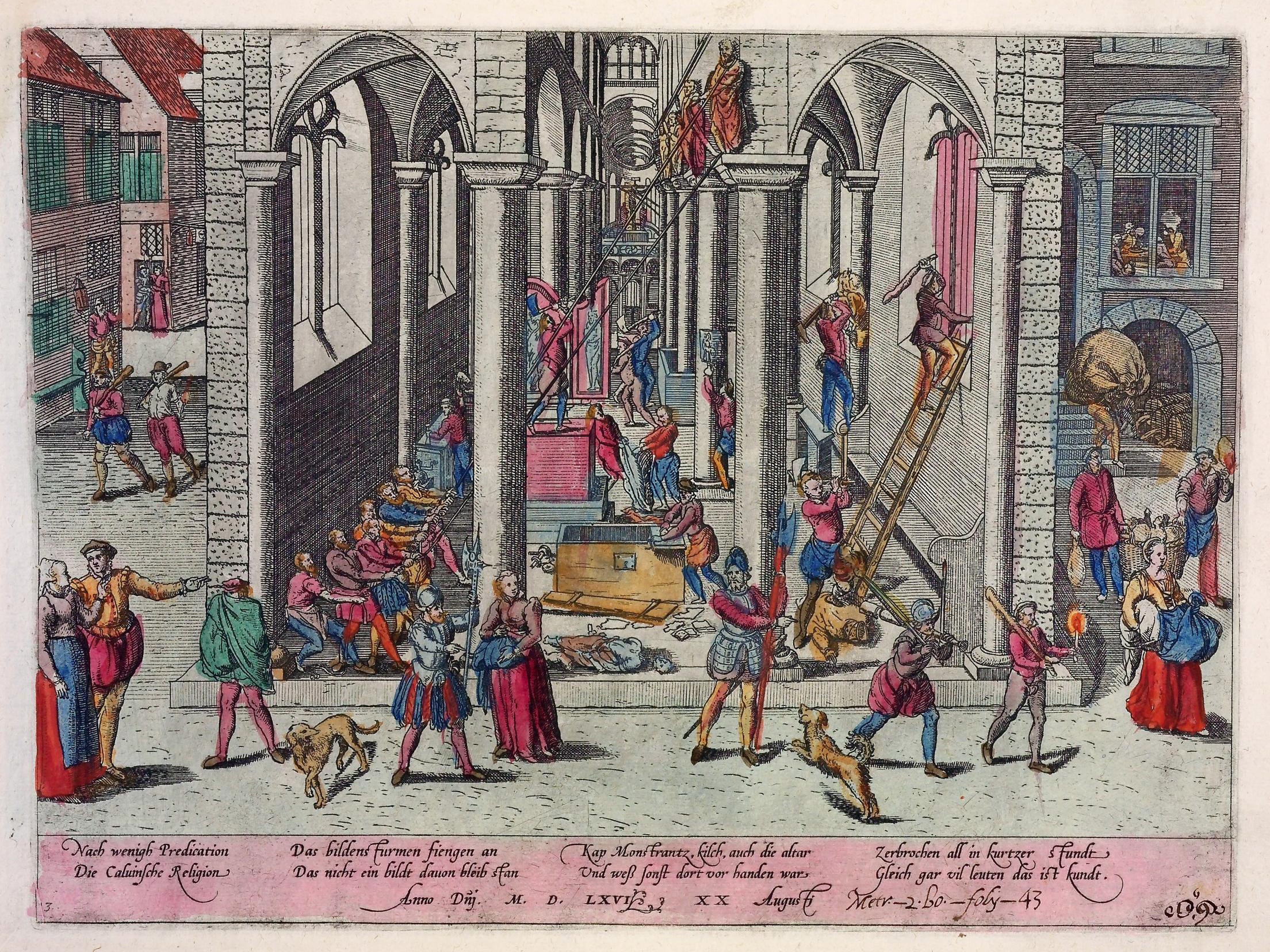
New day, old debate
Recently, Christians have been arguing about Calvinism…again.
I know, hold the presses.
Two questions immediately leap to mind: “What’s new?” and “Who cares?” In other words, given that there are so many more pressing matters demanding our time and attention as believers, what good can come of wading into this perennial, intramural food fight?
In a sense, we shouldn’t engage in such debates as an exercise of mere theological hair-splitting and one-upmanship, which is what most of them boil down to. But the nature of these recent discussions does highlight deeper trends within the Church that are themselves worth noting.
In terms of what’s new, the debates this time around were unique in that they were precipitated by a non-Calvinist layman, the political commentator, filmmaker, and sometime Christian apologist Dinesh D’Souza. Not only that, but the case against Calvinism was taken up most persuasively by the common sensical, Biblically-rich insights of a Nigerian biologist who ran circles around his Calvinist interlocutors, some of them seasoned debaters, despite being a theological nonentity prior to these discussions. These refreshing developments are undoubtedly signs of the times, providing further examples of the rise of both the non-specialist and the Christian Global South. It’s a new day for an old debate in the Church and this presents us with both new challenges and new opportunities.

So why should Christians care? Apart from these interesting sociological and demographic trends, the theological issues underlying these debates serve as an excellent reminder of the kinds of doctrines that worth sorting out rather early in the Christian journey so that we can move on in greater unity towards more pressing and profound matters of the faith (Hebrews 6:1–3):
“Therefore let us move beyond the elementary teachings about Christ and be taken forward to maturity, not laying again the foundation of repentance from acts that lead to death, and of faith in God, instruction about cleansing rites, the laying on of hands, the resurrection of the dead, and eternal judgment. And God permitting, we will do so.”
The problem is, as with so many other doctrinal controversies, the Church has clearly failed to sort this one out despite being at it for well over 1600 years, if one dates these debates back to the time of the immensely influential 4th century north African bishop Augustine of Hippo (354–430 AD).
Why is that? Well, if my assessment is correct, then one surprising consequences is that Calvinism, despite its billing as a profoundly deep discussion of utmost theological importance, is often a rather sophomoric subject, the classic fodder of late night college dorm room conversations, that is at best worthy of wrestling with in one’s callow youth before growing out of the “cage stage”1 and at worse a pesky distraction that keeps Christians in a state of perpetual adolescence and unproductive infighting. Clearly, this is not at all what the author of Hebrews would consider matters befitting mature Christian contemplation.
I have no illusions that anyone, much less I, will put an end to this never-ending debate. But perhaps it is possible to answer it so sufficiently, and with such reasonable, self-evident Biblical balance and clarity—such as was on display in the writings of the Nigerian brother mentioned above—that the debate effectively ceases to be the major distraction that it so often is, at least to the average, fair-minded Christian who has no axe to grind.
So, on the 509th anniversary of the Protestant Reformation,2 I thought it an appropriate occasion, in light of recent developments, to take some time to add my voice to a growing chorus of Christians who are, I think, rightly dissatisfied with where the current theological lay of the land on this subject. There is a growing sense, which I happen to share, that it is high time for a good shaking up on this topic so that we can all settle into something more stable and more Biblical (Hebrews 12:27; cf. Matthew 7:24–27).
My hope is that these recent conversations can serve as a teachable moment in which Christians can pause, reflect on the current state of American Church doctrine and practice and, in light of both recent and ancient church history, refine our beliefs, recalibrate our priorities, refocus our mission as the single, universal body of Christ.
Not so young, restless, and reformed
Before getting into the doctrinal issues at play in these debates, a bit of historical context would be helpful. We’ll start with recent, local history and zoom out to much earlier, universal considerations.
Some twenty years ago or so the ever changing winds of Christian doctrine (Ephesians 4:14) blew favorably into the sails of Reformed Theology, aka “Calvinism,” a system of Christian doctrine formalized during the Protestant Reformation, most notably by a Genevan reformer and Frenchman by the name of Jehan Cauvin, or John Calvin (1509–1564), the system’s namesake.3
For insight into how this rather angular, arcane theological system, which has always been a small minority, became so appealing to so many at the same time, one need look no further than Colin Hansen’s seminal 2006 piece in Christianity Today title “Young, Restless, Reformed,”4 which documented the rise of so-called “New Calvinism” in American evangelicalism.
In a nutshell, evangelical church life at the time, as is still largely the case today, was permeated by worldly pragmatism and shallow, superficial teaching. Young people, and young men in particular, craved real substance and meat, but were getting precious little of it from their pastors, enamored as they were with pragmatic, “seeker sensitive” church growth programs that helped churches like Saddleback and Willow Creek rise to prominence. Christians were tired of the anemic doctrine and “easy believeism” that was part and parcel of the Purpose Driven™ models, and, like good sheep, craved for more nourishing sustenance.
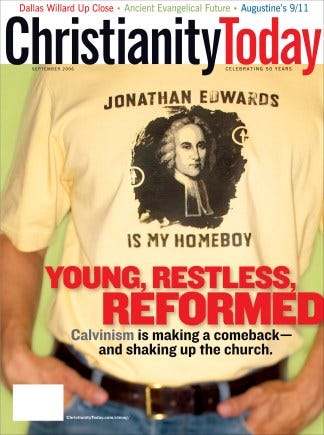
And, at the time, most of the men who were preaching weightier, challenging, theologically-robust sermons5 happened to embrace, or lean heavily towards, Calvinism, men like John Piper, John MacArthur, R. C. Sproul, Tim Keller and the like. By comparison, the comparatively informal, eclectic, contemporary doctrinal offerings from, say, your typical Calvary Chapel church seemed, by comparison, somewhat lacking in rigor and historical gravitas. In short, the theological pendulum swung hard from lighter, fluffier, half-baked fare to denser, rigid, over-cooked fair—not always the well-done, protein-rich steak that it seemed to be at the time, but still, a marked improvement in many respects.
I admit that I became somewhat swept up in these trends, though not intentionally so. It was just sort of in the water. At the time, as a college lowerclassman, I had set myself to read what I presumed to be the great classics of Christian literature. The Christian (in name only, unfortunately) college I was attending had an outstanding divinity section in its library, and it just so happened to be providentially located in my favorite study spot. So, when I should have been cramming for comparatively dull subjects like organic chemistry, I spent my time procrastinating with In the course of these studies I ended up reading a number of works by Calvinist preachers and theologians, such as Charles Spurgeon, B. B. Warfield, the Puritans, and others.
Yes, also I read a fair amount by non-Calvinist authors like C. S. Lewis, who was certainly no Calvinist, but their impact on me at the time was largely on other topics. With the help of modern resources like the MacArthur Study Bible and R. C. Sproul’s generally outstanding offerings through Ligonier Ministries, I found myself slowly but surely persuaded by their arguments. I even attended, for a short time, a couple Calvinist church fellowships, including a small country Reformed Baptist church in Texas and the now prominent Immanuel Church Nashville, but still mainly associated with non-Reformed, non-denominational, and charismatic churches, an odd combination, but one that makes sense given my upbringing.
But now, some two decades later, the tides are turning again and Calvinism now appears to be on the wane. This is in part thanks to much of the Reformed establishment coming out in 2020 in support of COVID hysterics, the George Floyd riots, Woke ideologies like critical race theory, along with standard co-morbidities like Trump Derangement Syndrome. Moreover, of the influential contemporary churchmen mentioned above (namely, Piper, MacArthur, Sproul, and Keller), only one, Piper, is still with us.
In brief, the movement’s leaders either haven’t aged well in the post-Trump, post-COVID cultural milieu, or have recently passed into glory, with few leaders, if any, waiting in the wings to fill their rather large shoes.
But there are deeper reasons for why Calvinism has, and really ought to, fall out of favor among balanced, Biblical believers, even those who rightly still identify as broadly reformed6 and Protestant, reasons having more to do with spiritual and theological truths that Christians will wrestle with more and more in the coming age of artificial intelligence.
Calvinism vs the Bible

Now, lest you think I am once again being caught up in the latest theological fad, no one has ever accused me of being a fad chaser. Thanks to my contrarian tendencies I tend to avoid popular Christian trends more than hipsters avoid Starbucks. In short, “I was critiquing New Calvinism before it was cool to do so.”
In truth, years before the current pushback from both known and unknown commodities alike, I had been rethinking my beliefs in this regard and questioning whether five-point Calvinism really represents the best understanding of the whole counsel of God on the twin Biblical truths of God’s sovereignty and holiness on the one hand and human freedom and moral responsibility on the other. I am now convinced that it does not.
Here, in brief, is a summary of the so-called “five points” of Calvinism, as organized by the familiar “T.U.L.I.P.” acronym, and what I believe the Bible actually teaches instead:
T. = Total depravity
Calvinism: Man is so depraved, God must save him so that he will believe. While not utterly depraved, that is, as depraved as he could be, since the fall, man is corrupted by sin in all aspects of his nature (e.g., mind, body, will, etc.) to such an extent that he cannot choose God, or even make a first move towards choosing God (“total inability”), prior to regeneration, being spiritually dead in trespasses and sins. Therefore, one must be born again to believe (“regeneration precedes faith”).
Bible: Man is so depraved, God must enable him to believe so that he may be saved. The Bible and universal human experience demonstrate that fallen man is born with a corrupted nature that is inclined toward sin. The questions are “how is it corrupted?”7 “how corrupted is it?”8 and “what are the implications of our corruption for man’s role in appropriating salvation to himself?”9 Without getting into the weeds of the related doctrine of original sin, it would seem that Calvinists take the implications of total inability too far.
On the one hand, one can hardly underestimate the depths to which sinful man has fallen and may further descend—on that we can all agree.
On the other hand, to say that man must not only be drawn by God before he can respond positively to His offer of salvation (John 6:44), but must also be born again, even before he places his faith in Christ, is to go beyond the teachings of Scripture in a manner that seems to contradict the logic of numerous Biblical gospel summons (Acts 16:31; Romans 10:9; etc.).
So why do they get the proverbial cart before horse in the ordo salutis, the logical “order of salvation”? Largely to remain consistent with their overstated understanding of total depravity. Here is a classic example of a Biblical system, and not the Bible itself, dictating the terms of one’s doctrine.
U. = Unconditional election
Calvinism: God unconditionally chooses who will believe and thus be saved. From eternity God freely chooses some fallen individuals to be saved (“election unto salvation”), while passing over others to be damned (“reprobation”), from eternity past not because of something good or evil in the ones elected (“unconditional”), but out of His sheer grace and mercy based solely on His own good pleasure and the free counsel of His inscrutable will (Romans 9:11–15; Ephesians 1:5; etc.).
Bible: God unconditionally chooses to save believers to serve in the capacity He determines. From eternity God freely chooses to save all fallen individuals who, by His gracious enablement, freely choose to repent and believe on the Lord Jesus Christ (“election unto salvation of believers by faith”).
Furthermore, God freely, unconditionally, and irrevocably (e.g., Romans 11:29) calls certain individuals for special roles and functions among His people Israel and the Church, sovereignly dispensing gifts to said individuals commensurate with their apportioned grace, faith, and office (“election unto service”).
L. = Limited atonement
Calvinism: Christ died only for the elect.
Since fallen individuals are unable to believe unless God first elects and regenerates them and not all individuals are regenerated, then although the atonement of Christ is of infinite value, and thus sufficient to cover the sins of the entire world, nevertheless it was intended to save only the elect (“particular” or “actual redemption”), since only the elect are actually saved. The atonement is therefore unlimited in worth but limited by God’s sovereign intent and application.
Bible: Christ died for all, not only the elect (i.e., those who would believe).
Since God’s stated desire is that all men should be saved (1 Timothy 2:4; 2 Peter 3:9; etc.), and thus He draws all men to Christ (John 12:32), Christ’s atonement is not only capable of saving all but was indeed intended to do so (1 John 2:2). However, since all men are not saved, the atonement is therefore limited by man’s free, sinful decision to reject salvation, contrary to God’s gracious provision and stated will that “all men everywhere repent” (Acts 17:30). The atonement is therefore unlimited in worth and intent by God’s sovereign plan, but limited in application by man’s sinful choice.
I. = Irresistible grace
Calvinism: God graciously ensures our belief. While God’s grace leading to salvation is necessarily resisted by those whom He has not chosen to grant the gifts of regeneration and faith, in the case of those He has chosen, God’s one-sided (“monergistic”) application of His saving grace to fallen individual’s nature so transforms it that the individual now finds God’s offer of salvation irresistibly appealing (“irresistible grace”), not because he or she couldn't resist it even if he or she wanted to, but because, by virtue of his or her renewed nature, he or she no longer desires to resist (“compatibilist freedom”).
Bible: God graciously enables our belief. While God’s grace leading to salvation is resisted by fallen man owing to his sinful choices stemming from his corrupted nature, yet he is doubly without excuse since God’s initiating grace so enlightens his mind and enables his will that he is capable of understanding and even accepting salvation, and yet may still refuse to do so. This is not because man’s will is ultimately sovereign, but because God sovereignly chose not to make use of external determining factors to predetermine man’s decisions in order that they may remain maximally morally meaningful (“libertarian freedom”10).
P. = Perseverance of the saints
Calvinism: All who truly begin the Christian life will finish it. Contrary to the concept of “once saved, always saved,” where a believer can be finally saved even if he or she apostatizes and fails to persevere in faith and good works to the end, perseverance of the saints reasons that since the Christian does nothing to contribute to his or her salvation—it is all of grace, not of works, including faith itself (Ephesians 2:8, 9)—therefore there is nothing the Christian can do to lose his or her salvation (“eternal security”). Thus, all who are truly saved at the beginning will certainly persevere to the end (Matthew 10:22, 24:13; Mark 13:13). Hence the saying “if you lose it [i.e., salvation], you never had it; if you have it, you’ll never lose it” (1 John 2:19).
Bible: Not all who truly begin the Christian life will finish it. Though many non-Calvinists hold to some form of eternal security, the Bible indicates in many places and in many ways that some (if not many or even most; Matthew 7:21–23; 1 Corinthians 10:1–5; Hebrews 4:1–11; etc.) of those who truly begin the Christian journey (i.e., true, and not merely false converts) may nevertheless fail to complete it through full and final apostacy (e.g., Hebrews 6:4–6).
Some argue that although the elect may lose their salvation,11 nevertheless certain Bible passages appear to indicate that they will not lose their salvation (e.g., Matthew 24:24). However, if one concludes that this possibility not only can but actually does sometimes occur, then this would also make sense on a libertarian free will view, for if salvation is initially appropriated to the sinner by his or her own free decision to repent and believe, then its continuation would also be contingent on ongoing, Spirit-wrought and grace-enabled (Philippians 2:12, 13; Galatians 3:3; Ephesians 2:8–10) belief and good works, a view that has ample Scriptural support (Matthew 7:19, 13:1–23; John 15:2; Romans 11:22; etc.).
Calvinist caveats
Moving beyond the five points, below, in order from least to most significant, are my top ten reasons for cautioning fellow believers against buying into the excesses of Calvinism—caveat emptor (“let the buyer beware”).
Man-centered carnality
This might come as somewhat of a surprise, as Reformed theology is often touted as “Christ-centered” or “Big God” theology. Isn’t a singular focus on God and his priorities Calvinism’s bread and butter? In theory, yes, but in practice, often not.
Instead, what one tends to find in Calvinist circles is an inordinate, sometimes shocking level of man-centered worldliness.
For example, although Protestants have historically been highly ambivalent towards images,12 a cursory examination of your average Reformed church, bookstore, ministry website, etc. will reveal prominently featured images, including busts and statues, t-shirts, cartoons, and even bobblehead dolls (no, seriously) depicting Reformed heroes of the faith.
While most of this is probably harmless,13 such merchandise does illustrate just how enamored many Reformed Christians are with their admittedly impressive lineup of theological heavy-hitters: Luther, Calvin, Knox, Bunyan, Edwards, Whitefield, Spurgeon, the list goes on and on. However it is precisely because these really were outstanding Christian men that they would undoubtedly be the first to distance themselves from such hero worship. Yet today, many prominent Reformed ministers enjoy a kind of celebrity status among their acolytes, who speak of their favorite preachers in hushed tones of starry-eyed admiration.
Paul noted similar personality cults among the Christians at Corinth and strongly warned against them (1 Corinthians 3:1–7):
“Brothers and sisters, I could not address you as people who live by the Spirit but as people who are still worldly—mere infants in Christ. I gave you milk, not solid food, for you were not yet ready for it. Indeed, you are still not ready. You are still worldly. For since there is jealousy and quarreling among you, are you not worldly? Are you not acting like mere humans? For when one says, ‘I follow Paul,’ and another, ‘I follow Apollos,’ are you not mere human beings?
What, after all, is Apollos? And what is Paul? Only servants, through whom you came to believe—as the Lord has assigned to each his task. I planted the seed, Apollos watered it, but God has been making it grow. So neither the one who plants nor the one who waters is anything, but only God, who makes things grow.”
Calvinists vociferously deny that the term “Calvinist” bears any resemblance to what was happening here at Corinth, insisting that it serves merely as a convenient theological short-hand to summarize their doctrinal commitments. But this objections do not pass the simple “duck test”: “If it walks like a duck, quacks like a duck, and has feathers like a duck, then it’s probably a duck.” Although no Calvinist would come right out and say “I am of Calvin” or “I am of MacArthur,” many say as much in so many words and actions. In short, if what Calvinists are doing in rallying behind the name of a mere man isn’t the kind of sectarianism that Paul was criticism among the Corinthians, then I don’t know what is.
In further support this diagnosis are the many other worldly tendencies among some of Calvinism’s most prominent and vocal present-day adherents. It’s common knowledge, for instance, that some of the most dishonest political actors, prominent moral failures, and racist, antisemitic, misogynistic, clickbaity conspiratorial “influencers” in recent years have hailed from the Reformed camp. Furthermore, divisive infighting and sinful squabbling are so endemic to Calvinism that they spawned the common saying “I might consider the ‘Doctrines of Grace’14 if their adherents were little more gracious.”
Systematic errors
The trouble with systems of understanding Scripture is that they have a tendency, over time, to take precedent over the very Scriptures they were designed to explain. The problem is not with systematic theology per se. Because Scripture is true, written by a single divine author, the Holy Spirit (2 Timothy 3:16; 2 Peter 1:21), and thus its various parts coherent, systematic understandings of Scripture are indeed possible.
But like sinless perfection, a perfect theological system that perfectly explains all Biblical teachings in relation to one another will most certainly allude us until we finally see God face to face (1 Corinthians 13:12). Priority, then, must always be granted to the Scriptures themselves, never the systems or confessions which purport to explain them, which are by their very nature provisional and subject to further revision and refinement, not unlike a scientific theory.
As such, Scriptural data must never be fudged or massaged or fabricated in order to fit the system. Rather, the system must always give way to the Scriptures. When one reads the Scriptures they do not come across as the carefully crosschecked doctrinal formulations of a card-carrying Calvinist, Arminian,15 Molinist,16 etc., suggesting that the inspired authors were less concerned with scoring points for a particular school of thought or making the systematic theologian’s life easier than they were with stating all the complimentary truths the Spirit gave them with equal force, clarity, and conviction, trusting that the same Spirit could help us sort it all out (John 14:26, 16:13; 1 John 2:27).
Mixed messaging
Calvinism also suffers from a serious messaging problem. Almost every tenet of the five points, for exampl, is not what its terminology would seem to imply. No wonder the uninitiated rarely represent their beliefs accurately—the Calvinist rarely represents them clearly! In writing, it’s always the author’s problem if the reader does not follow what he’s written, never the other way around.
But perhaps the deeper issue lurking behind this PR problem is that the labels accurately reflect a deeper confusion, even an unwitting duplicity. The term “compatibilism,”17 for example, purports to defend the notion that God’s sovereignty is compatible with human freedom, something every Christian, Calvinist or not, affirms. However despite the name, compatibilism ultimately fails to deliver on its promise,18 for in order to reconcile divine sovereignty with human freedom it waters down human freedom to such an extent that even Calvinists themselves often candidly and unblushing deny human free will altogether.19 What one is left with under compatibilism in terms of human freedom is, at best, a bare acquiescence to what God has predetermined us to do that, while technically voluntary, doesn’t rise to the level of substantial creaturely freedom the Bible seems to recommend.
Inductive vs deductive reasoning
Inductive approaches to studying Scripture and defining Christian doctrine start with the text of Scripture itself and induce from it general conclusions arising from its direct, positive statements.20
Conversely, deductive approaches attempt to logically deduce from Biblical passages or doctrines on a particular topic additional theological truths not explicitly found in them21—and often, in practice, flatly contradictory to them. Roman Catholicism has often done with when building its dogma, logically (albeit mistakenly) deducing, for example, the immaculate22 conception of Mary from its understanding of original sin and its transmission through biological reproduction.23 The reasoning goes that since Jesus was not born with original sin,24 then his mother must not have been either, something the Bible neither directly teaches nor even suggests (indeed, quite the opposite; Luke 1:46). Thus one error is used to logically deduce others, yielding conclusions that are both logical and unbiblical.
Calvinism also falls into this deductive pitfall. For example, the statement “Christ died only for the elect” at first seems so jarringly out of step with so many explicit Biblical statements that one might wonder how anyone, much less an astute exegete of Scripture, could possibly conclude this. But if you begin with an erroneous understanding of original sin and its consequences vis-à-vis fallen human nature, then the conclusion that Christ died only for the elect follows as the night follows the day—yes, Calvinism is thoroughly logical.
Yet valid logic is only one of several necessary ingredients needed to arrive at sound conclusions. If even one of any number of premises in a logical syllogism is false, then even valid logic will only produce false conclusions.
Hebrew dynamism vs. Greek determinism
How does one properly balance the twin truths of God’s sovereignty and human responsibility presented to us in Scripture?
The picture one gets of God’s interactions with humanity in the Bible seems less one-sided, top-down, and micromanaging than Calvinism often portrays. Yes, it’s true that not even a sparrow falls apart from God (Matthew 10:29). But time and again in Scripture we see humans acting contrary to God’s will and God reacting dynamically to these sinful choices, even to the point of “regretting” that He had ever made mankind in the first place (Genesis 6:6), something no Calvinist would be inclined to write. Yet examples of this kind of dynamic abound in Scripture (Jeremiah 19:5; Matthew 23:37; Luke 13:34–35; etc.).
In a number of respects Calvinism seems more ideologically at home is in its extra-Biblical, pagan philosophical analogs, such as Neo-Platonism, Stoicism, Gnosticism, and Manicheism, each of which contain either strong fatalistic or deterministic elements and each of which influenced Calvinism’s original progenitor, Augustine.
In an overzealous effort to uphold God’s prerogatives and keep humans in their rightful place, Calvinism overstates the truths of God’s sovereignty and man’s depravity at the expense of the truths of man’s freedom and responsibility, to name just a couple examples. True sovereignty is more free and less insecure than Calvinism supposes, the polar opposite of overweening tyranny. Biblical determinism is, as its name suggests, overdetermined.
Early Christian views
As mentioned in the previous point, Calvinism appears to be more of an invasive species in the Christian theological ecosystem than a native one. As even mainstream Calvinist thinkers freely acknowledge, the Early Church Fathers simply did not teach the kind of hard theological determinism that would only later be introduced into the Church during the time of Augustine (see image below). What they did teach, as one would expect, was in much closer alignment with the Jewish dynamism of the Apostles and Old Testament than the heavy-handed, Greek-influenced determinism of Augustine and his followers.
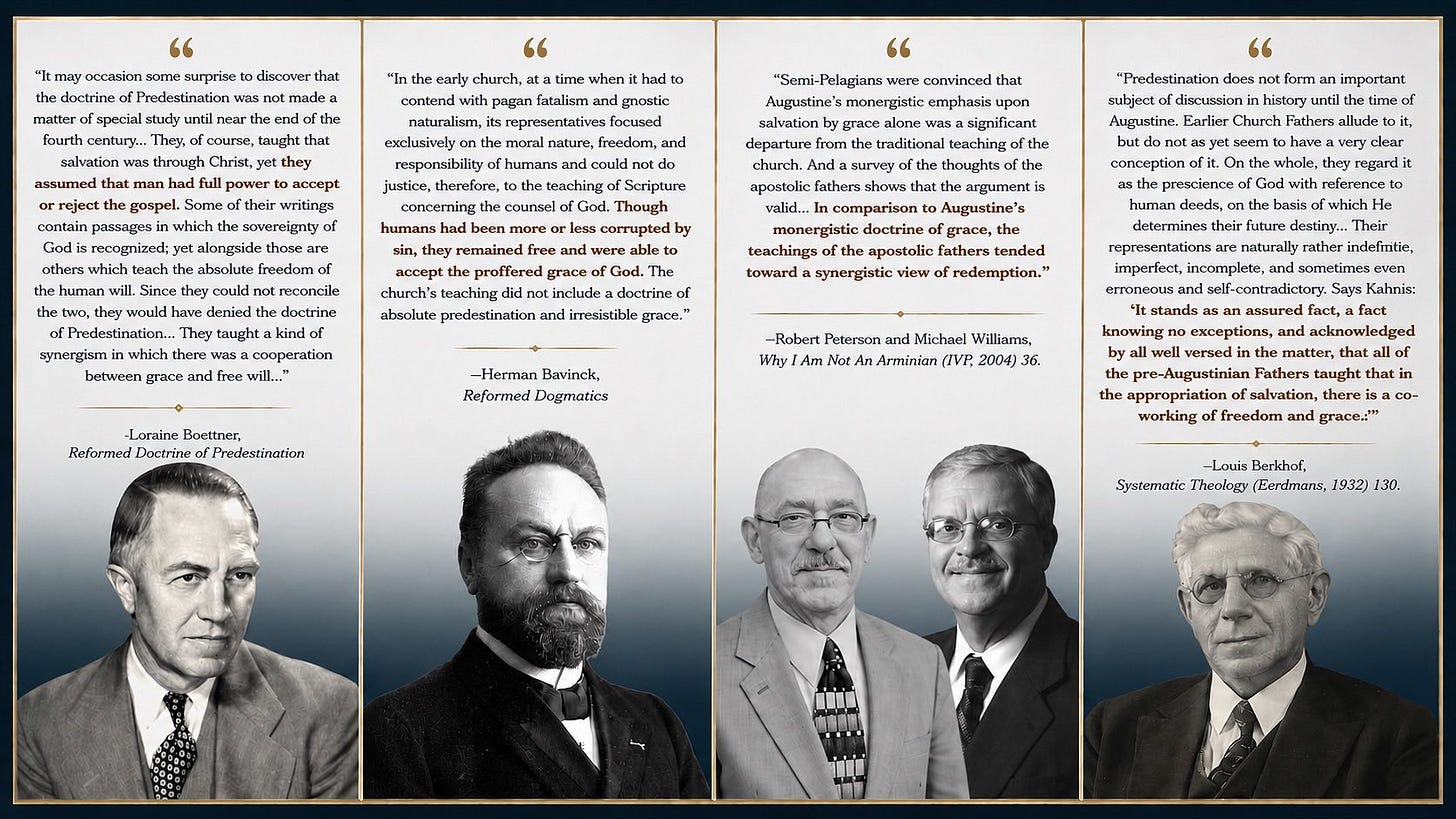
Top Reformed theologians admit that the Augustinian/Calvinist understanding of salvation is not rooted in the earliest teachings of the Church. Image source: Soteriology 101. Lack of grammatical-historical exegetical support
It turns out that while many Calvinist concepts appear grounded in Biblical terminology, this is usually accomplished by importing 4th/5th century Augustinian, or even 16th century Calvinist, concepts into Biblical terms that actually meant something quite different to both the Biblical authors and their original audiences.
Thus, every time the word “predestination” appears in Scripture, it tends to be autofilled with the related Calvinist concept of “predetermination,” which may sound synonymous at first but is actually a very distinct concept.25
This phenomenon occurs repeatedly in Romans chapter 9, the Calvinist “Helm’s Deep,” an impenetrable theological fortress establishing Reformed theology on strictly Biblical grounds beyond all reasonable doubt. On closer examination, however, it is nothing of the sort. In fact, by substituting anachronistic Calvinist presuppositions for Hebrew and early Christian concepts, ones that stem from the very Old Testament passages that Paul cites in this chapter (Exodus 33:19, Isaiah 29:16, 45:9, Jeremiah 18:1–11, etc.), Calvinists eisegete a meaning into the text that neither Paul nor his original readers and hearers would have recognized.
The importance of human choice
Appropriate concerns over human freedom and choice have nothing to do with defending “almighty man” and exalting his supposedly inviolable and absolute autonomy, a la William Ernest Henley’s poem Invictus:
“I thank whatever gods may be
For my unconquerable soul. […]
It matters not how strait the gate,
How charged with punishments the scroll,
I am the master of my fate:
I am the captain of my soul.”
Clearly, this luciferian view of freedom is the farthest thing from a proper Christian understanding.
No, the proper Christian concern when it comes to rightly understanding human choices is to defend the holiness of God in light of the sinfulness of man. Obviously, whatever kind of freedom humans were given at creation, and whatever remained after the fall, has been severely abused to choose sin rather than God. In light of this, are we to believe that God both unilaterally26 and causally27 determined28 each and every one of our sinful thoughts, words, and deeds, and yet somehow is not the author of evil?
The Calvinist accounting of God’s sovereign decrees in relation to man’s choices takes Biblical teachings to uneccesary extremes. The motive may be noble, but the outcome is unacceptable.
For example, according to Calvinism, since salvation is 100% a gracious work of God from start to finish (Romans 8:29, 30; Ephesians 2:8, 9; etc.), then even if only 1% of it, say, our decision to believe in Christ, depended upon us, then no one would be saved. While this framing may sound pious, it is really just misguided, for faith, understood Biblically, is not a meritorious work of the law that contributes to our salvation, but merely an empty hand that receives it (Romans 3:28, 4:5; Galatians 2:16; etc.).
Human choice, therefore, is incredibly important, literally a matter of life and death (Deuteronomy 30:19):
“This day I call the heavens and the earth as witnesses against you that I have set before you life and death, blessings and curses. Now choose life, so that you and your children may live!”
God has sovereignly determined to leave our choice of eternal destiny up to us, a sobering thought if ever there was one. If we choose death, then that is 100% on us, for God would have us choose otherwise (Ezekiel 33:11). If we choose eternal life, then all credit goes to God, since there is no merit whatsoever in merely receiving a free gift (Romans 6:23) and it is God who is responsible not only for providing the gift itself, but for enabling and encouraging us to receive it (Philippians 2:13)!
What more could God do? Seal the deal for us in advance and guarantee our decision one way or the other? While He certainly could do that, He quite intentionally chooses not to, because if He did, then our choice would be no more morally significant than an apple’s “choice” to fall to the ground at a rate of 9.81 meters per second squared. The effect would be as automatic as a known force acting on an object of known mass.29
Coherence of God’s attributes
God is neither confused nor the author of confusion. He speaks with neither forked tongue nor both sides of His mouth—these being Satan’s preferred modes of communication.30 In short, God says what He means and He means what He says.
So when Calvinists distinguish between God’s decretive will31 (i.e., that which God wills according to His immutable sovereign decrees), God’s preceptive will32 (i.e., that which God wills in His precepts, laws, and commandments), and God’s dispositional will (i.e., that which God wills according to His nature, disposition, and good pleasure), we have to be careful that what start out as helpful distinctions in God’s will do not become unhelpful disjunctions.33
While there is some truth to these distinctions, rather than representing three competing divine wills, each must be viewed as a distinct, but inseparable, aspect of God’s united divine will. In other words, to say that God causally predetermines by His decretive will that which He condemns in the strongest and most vivid possible terms by His prescriptive and dispositional wills seems to introduce a kind of double-mindedness into the character and will of God that suggests a lack of ontological34 coherence and moral integrity.
Instead of this, what’s to stop us, Biblically speaking, from saying that God, when ordaining the parameters of the actual world, leaves the precise form at least some ends take, as well as at least some of the means by which those ends are obtained,35 to some extent up to contingent human choices?36
In fact, the Bible suggests these very things (Esther 4:14; Isaiah 59:16; etc.). If we often say of mere human purposes that “there’s more than one way to skin a cat,” then how much more is this true for God? If God ordains a particular end, or range of ends, does He not have both the liberty and capability of achieving it, or them, in more than one way if it is His good pleasure to do so? One thing, though, is for certain: if God sovereignly ordains that the proverbial cat be skinned, then one way or another, it will be!37
The holy character of God.
When God revealed His character to Moses at Mt. Sinai, He declared both His mercy and His justice (Exodus 34:6, 7):
“And He passed in front of Moses, proclaiming, ‘The LORD, the LORD, the compassionate and gracious God, slow to anger, abounding in love and faithfulness, maintaining love to thousands, and forgiving wickedness, rebellion and sin. Yet He does not leave the guilty unpunished; He punishes the children and their children for the sin of the parents to the third and fourth generation.’”
This is the highest and most important task of the theologian, and therefore of all believers:38 To rightly represent each and every aspect of who God is without compromising any one of them in the process. Milton captured this well as he invoked the Spirit’s aid to his “ adventrous Song”: 39
“[…] What in me is dark
Illumin, what is low raise and support;
That to the highth of this great Argument
I may assert Eternal Providence,
And justifie the wayes of God to men.”40
So, if God is both good and severe (Romans 11:22), gracious and just, then we must ask ourselves: Does Calvinism do full justice to both, or does it emphasize one to the neglect of the other?
When it comes to God’s goodness, of course God doesn’t have to give grace to any fallen creature, much less all, much less to all equally. But, nevertheless, simply because of who He is by nature (e.g., 2 Timothy 2:13), it is His desire to freely show mercy to all (Romans 11:32), in spite of our best efforts to the contrary.
And with respect to God’s justice, while it would certainly not be unfair of God to allow all sinners to incur the just judgement they deserve, namely, eternal conscious torment in hell, neither would it seem to be particularly gracious.
We see then that when it comes to God’s goodness and justice, He is not satisfied with merely keeping to the bare letter of the law, whether it be the law of love (John 13:34) or the law of Sinai (Exodus 20), which are really one and the same (Matthew 22:37–40; Romans 13:8). Rather, God’s love is everlastingly steadfast (Lamentations 3:22, 23) and His justice beyond reasonably fair (Genesis 18:25; Psalm 36:6), seeming to go the extra mile in both respects to acquit Himself of all potential charges of inclemency or partiality, showing Himself beyond all question to be who He claims to be, namely, the LORD (Exodus 34:6, 7; Isaiah 42:8)!
So, again, when Calvinists claim that God causally predetermines each and every one of a person’s sins, such that he or she necessarily commits each act and could not have done otherwise, and yet punishes the very sins He ordained, I do think we that we have a case of injustice at worst and a conflict of interest demanding recusal at best, not because God uses sinful agents and their sinful actions for His own good purposes, as Scripture assures us (Genesis 50:20; Isaiah 10:5–7; Jeremiah 25:9; Romans 8:28; etc.), but because He literally causes41 the sinful actions themselves, something Scripture repeatedly and emphatically denies (Psalm 5:4, 5; Habakkuk 1:13; James 1:13; 1 John 1:5). That is simply giving God way too much credit for sin (when really He deserves none) and sinners way too little (when really we deserve it all).
In sum, the Calvinist portrayal of God is both less good and less just than the holy God of Scripture truly is. And that, in the final analysis, is Calvinism’s ultimate, two-fold flaw.
Reformed or reforming?
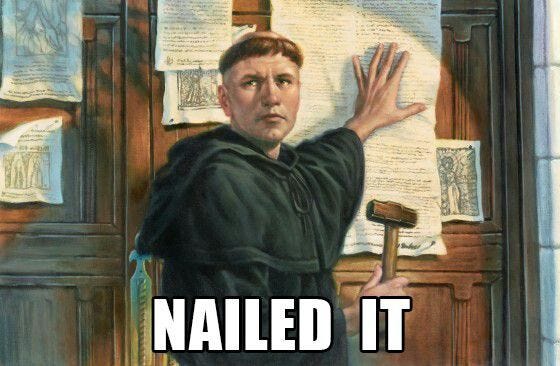
Looking forward we must ask ourselves an important and often debated question: “Is the Reformation over?”
Actually, even most Reformed Christians would say, “No,” not only because the Roman Catholic Church is still Roman Catholic, but because even in the Reformed ranks there is a constant need for ongoing reform, not of their basic doctrinal affirmations, which were largely settled during the Reformation or not long thereafter, but rather of their lack of conformity to them. This is where the famous Protestant motto semper reformanda (“always reforming”) came from.42 In this conception, the church is Reformed in the past tense with respect to its doctrine, but is reforming in the present tense with respect to its practice, which often falls short of its ideals.
But did even the great Magisterial Reformers of 16th and 17th centuries fully and finally reform the doctrinal and practical accretions43 of Roman Catholicism, bringing the Church back to her truly catholic (i.e., universal), apostolic form, to “the faith once for all delivered to the saints” (Jude 1:3)?
The answer here is also most certainly “No,” as subsequent reflection and scholarship has revealed, as many even in the days of the Reformation contented, that the Reformers frequently either did go far enough in their reforms, went too far, or did not reform at all. In fact the Reformers were the first to admit that church councils and confessions of faith, be they Catholic or Reformed, while important and necessary, often err or contradict one another, and thus should always be subject to the sole and final authority of “Scripture alone” (sola scriptura).
Beyond its soteriology,44 Reformed theology still has many medival Romeish and even ancient doctrinal holdovers that, despite having impressive provenances, nevertheless do not originate from the Apostolic doctrines of the early church.45 I am thinking here of such doctrines as infant baptism, divorce exceptions, cessationism, supersessionism (aka “replacement theology”), amillennial and postmillennial eschatological, and many others departures from the “pattern of sound doctrine” handed down to us by Christ through His holy Apostles (2 Timothy 1:13; Titus 1:9, 2:1; etc.). Even today their are many doctrinal proposals, both good and bad, contending for entry into Protestant thought, necessitating constant vigilance and discernment.
So, what am I suggesting here? That we re-invent the wheel and pretend as though the Reformation never happened and that church history restarts with each succeeding generation? Not at all, for to do so would not only be uneccesary, but also foolhardy and arrogant, neglecting the priceless, hard-won insights of the “great cloud of witnesses” (Hebrews 12:1) that have come before us.
Rather, Christians in general, and especially those of the Western tradition—including Roman Catholics!—should all be on board with the Reformation project, broadly construed. As heroic saints like Jan Huss and John Wycliffe remind us, such efforts long preceded the 16th c. and there is no reason to prematurely end them, which in my mind would be any point prior to the consummation of the New Heavens and New Earth.
Though I am a former Calvinist, I am not a former reformer, that is, one who is committed to the perpetual and glorious task of seeking ever greater conformity to Christ, the head, among his people, the body of Christ, for this is what all believers are truly predestined to (Romans 8:29; cf. 2 Corinthians 3:18). To be a true son or daughter of the Reformation, one must be committed to building on the good—not perfect—foundation laid by these truly great exceptional men and women. Let’s all agree that it was a great start, not a perfect finish. Further, we must broaden our understanding of what it means to be a reformer to include those who came long before the Protestants, namely, Christ Himself, John the Baptist, Josiah, Hezekiah, Elijah, and many others.
Luther’s breakthrough—that justification was by faith alone, and not by works—was a real significant recovery of Biblical doctrine that had be largely obscured by Rome’s sacramental abuses. But subsequent generations have inherited an over-emphasis on grace and an almost genetic allergy toward works.46 This is misguided and only hurts our witness to those who want us to practice what we preach (Matthew 23:3).
Protestants have a reputation for being schismatics and divorced from the historic faith. We must move beyond denominational and theological labels and work towards recovering the collective insights of all of God’s people, a project some have termed “theological retrieval.” We must reinfuse the supernatural into our post-Enlightenment, materialistic Western worldview, a project often referred to as “theological reenchantment.” Although these both have their dangers, they are nevertheless good and very necessary and important endeavors. But the one that we are called to at League of Believers involves not merely changing our doctrine or our way of viewing the world but mainly our actions.
Can one complete a never-completed Reformation, or a never-ending processed of reforming? Can one pick the last weed from one’s garden, never to pluck another one again? In the New Heaven and New Earth, yes, but not in our present, a wheat and tares world.
“Cage-stage Calvinism” refers to the infamous period immediately following one’s conversion to the Calvinist system in which they incessantly pester all of their family, friends, and fellow churchgoers into debates on this topic, hoping to convince them too of its merits. This period is called the “cage-stage” since such believers are best kept locked in a metaphorical cage before their evangelistic zeal subsides enough for them to be released back into polite Christian society.
Typically dated to October 31st, 1517, the day Martin Luther is said to have nailed his 95 Theses to the Wittenberg Castle Church door.
In spite of the fact that he is a Frenchman, and French intellectuals have shall we say a rather spotty track record, I am choosing not to engage in “Calvin bashing” here, though I do disagree with many of his doctrinal positions quite strongly. At the same time, I consider him a brother of immense importance and achievement in the life of the Church. Besides, Calvinism as a concept and doctrinal position has developed so much, and become so much broader, than one man’s ideas. In fact, most of what we now call Calvinism is really traceable back to Augustine.
Hansen later published a full-length book of the same title and himself become engrossed in the movement through his efforts with The Gospel Coalition (est. c. 2007), a once highly respected evangelical parachurch organization that has since fallen into disrepute due to its embrace of wokeness in 2020 and thereafter.
If you are a Gen Zer, a “sermon” was kind of long-form podcast, only a monologue given before a live audience rather than a dialog between two individuals in a stuido.
Lowercase “R,” not the specific, capital “R” Reformed denomination.
That is, is Adam’s initial sin and the guilt thereof imputed to us at conception/birth (“inherited guilt”) or are we corrupted only by our own actual sin, perhaps beginning at an age of accountability?
That is, is our corruption radical (i.e., stemming from the root or core of our nature/being) and pervasive (i.e., it strongly impacts every part of our human nature/being), accidental (i.e., restricted to peripheral aspects of our nature/being, but not its core essence) and limited (i.e., it less strongly or even weakly impacts some, but not other aspects of our nature/being), or something in between?
That is, is man so corrupted that he cannot even respond to God’s gracious offer of salvation (even, say, with the help of prevenient grace) without first being born again?
The ability to choose free from outside factors that would determine one’s decisions such that they are ultimately up to the individual who is making the decision, rather than someone or something else. Though libertarian free will is sometimes defined as one’s ability to choose other than or opposite to how chooses in any given situation, this definition does not hold in a number of significant theological and philosophical applications, and thus is not preferred by this author.
That is, it is at least possible that the elect can be finally lost.
Rejecting out-of-hand, for example, both Eastern icon veneration and Western Catholic cults of Mary and the saints, along with their incipient, if not full-blown, idolatry.
I do not share the extreme iconoclastic tendencies of some Reformed Christians who often too readily (though perhaps understandably, given their historical origins) claim violations of the second commandment when there are none.
Another name for Reformed theology and Calvinism.
Related to the theological system formulated as an alternative to Calvinism through the influence of the Dutch Reformed churchman Jacobus Arminius (1560–1609).
Related to the concept of scientia media (“middle knowledge”) as formulated during the Catholic Counter-Reformation by the Spanish Jesuit priest Luis de Molina (15351–600).
A rare messaging win for the Calvinist, who can technically label his detractors “incompatibilists,” which sounds rather negative and off-putting.
For example, the very impressive Westminster Confession of Faith famously says in “Of God’s Eternal Decree” (Ch. III, section 1):
“God from all eternity did by the most wise and holy counsel of His own will, freely and unchangeably ordain whatsoever comes to pass; yet so as thereby neither is God the author of sin; nor is violence offered to the will of the creatures, nor is the liberty or contingency of second causes taken away, but rather established.”
However, the confession goes on to define human free will (Ch. IX “Of free will”) in such a way as makes it very difficult, if not impossible, to avoid the conclusions that our choices are not truly free and that God is indeed the author of sin.
For example, Martin Luther said the following in his classic 1525 treatise De Servo Arbitrio (“On the Bondage of the Will”):
“As to myself, I openly confess, that I should not wish free will to be granted me, even if it could be so, nor anything else to be left in my own hands, whereby I might endeavor something toward my own salvation.”
And, perhaps even more famously:
“So man’s will is like a beast standing between two riders. If God rides, it wills and goes where God wills [...]. If Satan rides, it wills and goes where Satan wills. Nor may it choose to which rider it will run, or which it will seek; but the riders themselves contend who shall have and hold it.”
Inductive approaches are commonly utilized in expository preaching and teaching.
Deductive approaches are more common in topical preaching and teaching.
I.e., sinless.
According to the Augustinian and Reformed understanding of the transmission of original sin.
In the Augustinian and Reformed understanding, original sin refers to the inherited guilt of Adam’s first transgression and the corrupted human nature that resulted from it.
I owe this insight to the late English Bible teacher David Pawson (1930–2020).
That is, based on His decision alone imposed upon the creature, and not based on anything foreseen or actual in the creature that God responds to (similar to unconditional election).
Meaning not that God directly or immediately causes the thing He determines, but that He sets in motion, from both the primary cause of His creative decree as well as the secondary creaturely causes that flow from it, absolutely everything that comes to pass in space and time.
This phraseology is borrowed from philosopher and theologian Dr. William Lane Craig. For more on his views on this subject, see his outstanding book The Only Wise God: The Compatibility of Divine Foreknowledge and Human Freedom.
This is known as Newton’s Second Law of Motion, which is represented by the equation “F = ma,” where “F” is the net force, “m” is the object’s mass, and “a” is its acceleration.
See Ch. 2, “The Serpent’s Playbook,” from the League of Believers eBook Outwitted.
Aka “sovereign will.”
Aka “prescriptive will.”
For example, some, citing verses like Matthew 6:10 and Romans 12:2, have sought to distinguish God’s “perfect” and “permissive” wills, but this distinction is often artificial and has been abused as an excuse for sin (Jude 1:4).
That which pertains to the nature of God’s being as a tripersonal (i.e., trinitarian) deity.
Not whether these ends will be obtained, but merely the means by which they will be obtained (that is, when, where, by whom, etc.) and the exact configuration that the final end will take. This need not be the case for every end, as God may choose to specify as little or much as He desires in terms of the specifics for any given scenario, but it could be the case that in some, if not many instances, God leaves at least some ends and means relatively underdetermined.
Contingent, but foreknown and, in that sense, foreordained. In other words, God’s foreknowledge of counterfactuals of creaturely freedom, that is, what a creature would do in any possible scenario, are most likely taken into account logically prior to His divine creative decree (e.g., Proverbs 3:19, 8:22-31), as is suggested by most theories of God’s omniscience as well as Molinist conceptions of middle knowledge.
And, if He is fine permitting either a cat or a calf to be skinned, so to speak, or else a lamb, or goat, or turtledoves, or pigeons, or fine flour to be offered instead (Leviticus 5:1–13), then that is totally God’s prerogative.
Since all believers are theologians (e.g., 1 Peter 2:9).
John Milton, Paradise Lost, Book I.
Ibid.
Though, to be fair, according to Calvinists this is mediated indirectly through secondary (i.e., creaturely), and not primary (i.e., divine) causes, such that the sinner, and not God, is the “efficient cause” of sin.
For example, see Robert Godfrey’s article “Semper Reformanda in its Historical Context,” Tabletalk Magazine.
What Jesus referred to as “the commandments of men” (Matthew 15:9), which permeated the teachings of the Pharisees.
I.e., doctrine of salvation, which in the case of Calvinism is summed up in the five points.
Doctrinal developments are not necessarily bad, as our understanding of Biblical teaching can and should deepen and clarify over time, but, importantly, such depth and clarity is valid only when added to doctrines that have their roots in the Apostolic deposit of faith (1 Timothy 6:20; 2 Timothy 1:14, 2:2).
As Luther himself observed (Table Talk (Tischreden), Entry #630 (or #631 depending on version), recorded in the fall of 1533 by Veit Dietrich):
“The world is like a drunken peasant. If you lift him into the saddle on one side, he will fall off again on the other side. One can’t help him, no matter how one tries. He wants to be the devil’s.”
This saying has often been modified as:
“History is like a drunk man on a horse. No sooner does he fall off on the left side, does he mount again and fall off on the right.”